Wooden model ship kit guide
Catalogue phrases like plank on bulkhead, double planked and boxwood fittings are commitments. Here is what each one is asking of you before you pay for it.
- Last reviewed 20/08/2026
- Guide
- Static display models
- Hull types
- Three
- Planking
- Single or double
- Usual scales
- 1:50 to 1:100
- Time
- Measured in months, not evenings
A wooden ship kit is not a kit in the plastic sense. It is a bag of raw material, a set of plans, and an assumption that you will make the parts fit. That is why the same subject appears at wildly different prices, and why the price tells you very little.
Three ways a wooden hull is built
| Type | How it works | Who it suits |
|---|---|---|
| Solid hull | A carved block, sometimes roughly pre-shaped, sanded to the section drawings | Anyone comfortable with a rasp; fastest route to a hull |
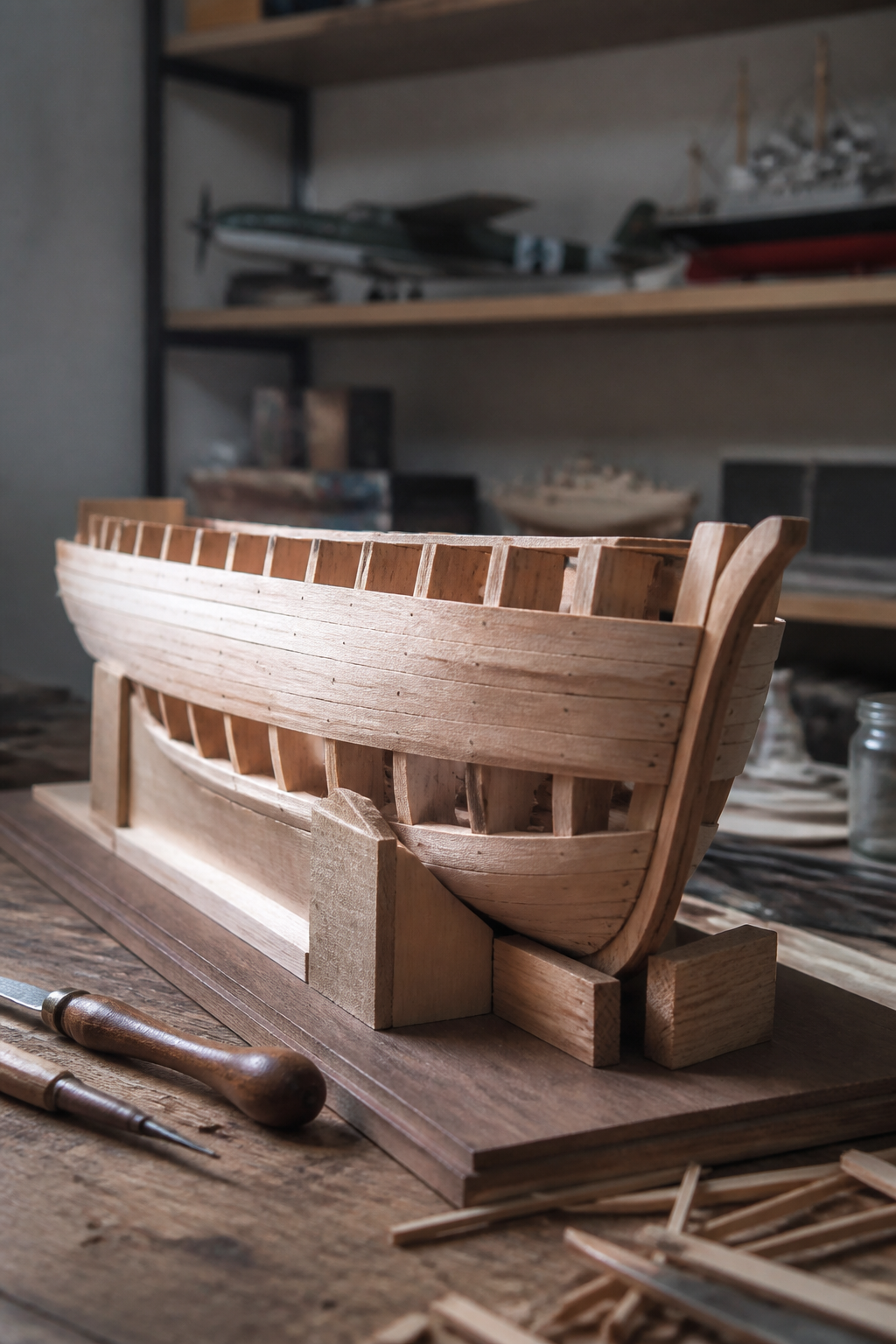
| Plank on bulkhead | A central spine with slotted bulkheads, planked over with thin strips | The mainstream, and the right first choice |
| Plank on frame | Every frame of the real ship reproduced, often left partly unplanked to show them | Experienced builders; slow, expensive and beautiful |
The overwhelming majority of kits on sale are plank on bulkhead. If a kit does not say which it is, it is plank on bulkhead.
Single or double planking, and why it matters more than the wood
A double-planked hull gets two layers. The first is soft, cheap wood, usually lime, glued and pinned over the bulkheads, then sanded fair and filled where needed. Nobody sees it. The second layer is thin strips of a decorative hardwood laid over the top, and that layer is the finished surface.
This matters because it means a double-planked kit gives you a practice run. Your first attempt at bending, tapering and edge-fitting planks is hidden. On a single-planked kit, the first attempt is the finished hull. For a first wooden ship, double planking is worth paying for.
The word that governs the whole job is fair: a hull is fair when a plank laid along it touches at every point, with no flats and no hollows. Bulkheads are bevelled before planking so that the plank lands flat on each one. Skipping the bevelling is the most common reason a first hull ends up lumpy.
The woods, and what they tell you about the kit
| Wood | Colour and grain | Used for |
|---|---|---|
| Lime, also sold as basswood | Pale, almost no visible grain, cuts and bends cleanly | First planking, and any surface that will be painted |
| Walnut | Mid brown, open grain that can look coarse at small scale | Second planking, deck furniture, masts on cheaper kits |
| Boxwood and pear | Fine, even grain that holds a crisp edge | Visible planking, small fittings, carved detail |
| Mahogany and sapele | Red-brown, decorative, moderately open grain | Second planking on decorative models |
| Tanganyika | Light, straight and stable | Decking and structural strips |
Grain scale is the thing people miss. At 1:75 a plank is a few millimetres wide, and a wood with visible open grain looks, at that size, like a ship built of driftwood. Boxwood and pear look right at small scale precisely because they have almost nothing to see.
Fittings: cast, turned or printed
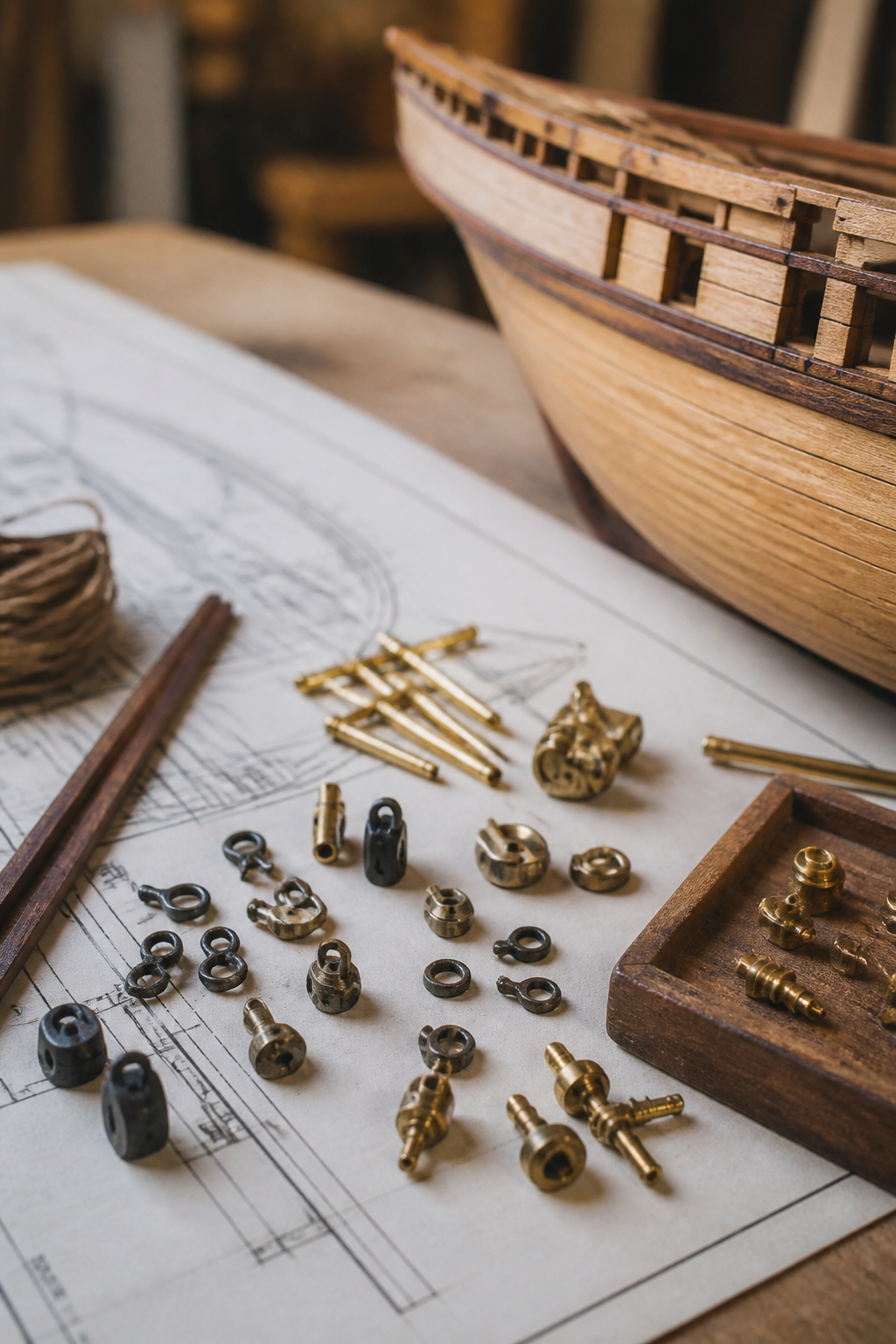
Kits supply fittings in three forms, and the mix tells you where the maker put the budget. Cast white metal, sometimes called britannia metal, arrives with flash and mould lines that have to be cleaned off, and usually looks better blackened or painted than bare. Turned brass, for cannon and eyebolts, is crisper and needs blackening to stop it reading as jewellery. Printed resin fittings, increasingly common, are the sharpest of the three and the most fragile.
Whatever the kit supplies, budget an evening for cleaning fittings before anything is fitted. It is dull, and it is the difference between a model that looks made and a model that looks assembled.
The plans and instructions are the real product
Two kits of the same ship, with the same wood, can differ by a hundred hours of frustration purely on documentation. Before buying, find out:
- How many full-size plan sheets there are, and whether the frames and planking bands are drawn at full size.
- Whether the written instructions have been translated properly, or whether they are a caption sheet.
- Whether the rigging is given as a numbered plan with thread diameters, or as one general arrangement drawing.
- Whether anybody has published a build log of that kit. A well-documented kit is easier than a better kit nobody has written about.
Standing and running rigging
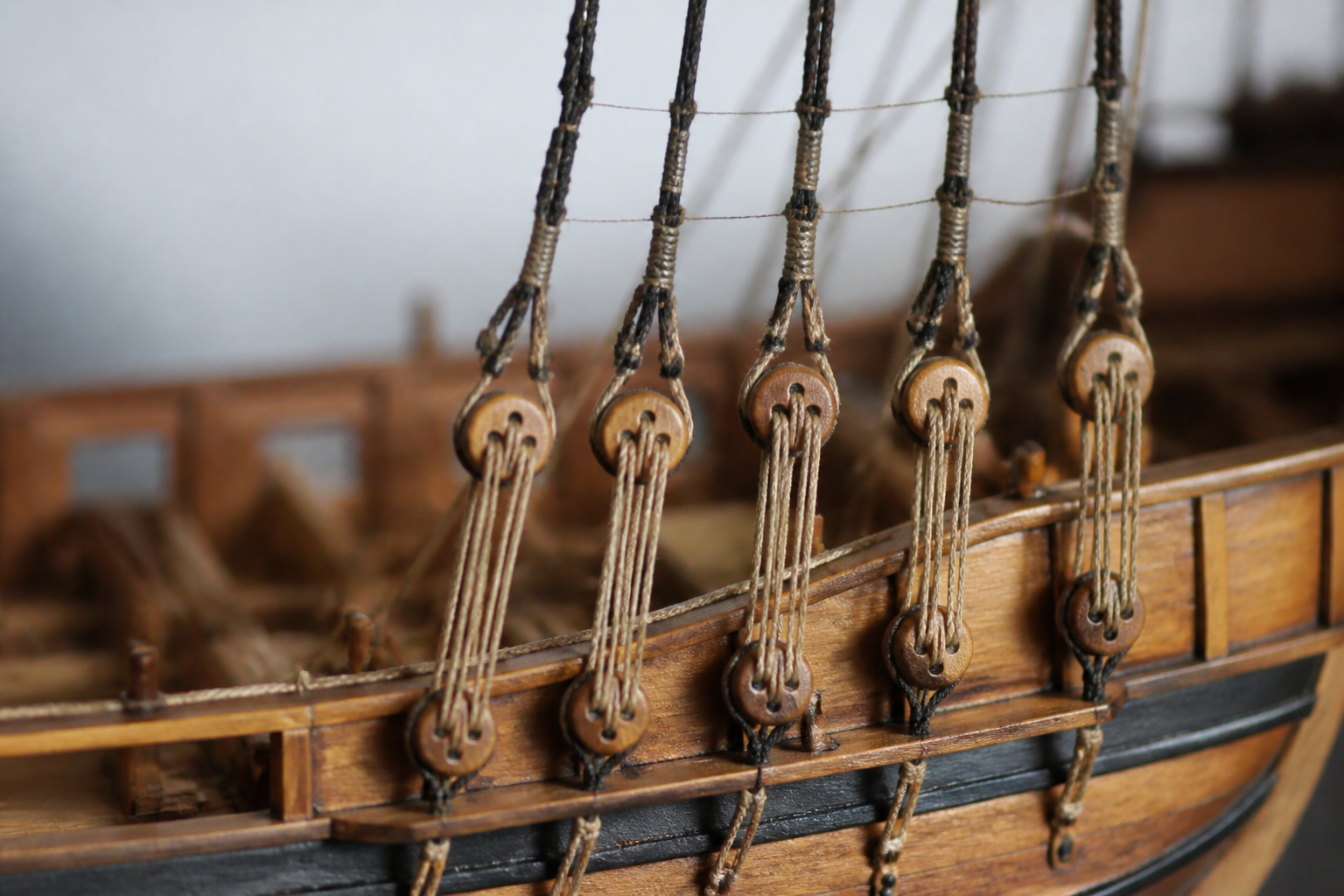
Rigging divides in two, and every rigging plan assumes you know which is which. Standing rigging is fixed: shrouds, stays and backstays that hold the masts up. It was tarred, so it is dark brown or black. Running rigging moves: halyards, braces and sheets that work the yards and sails. It is left natural, so it is pale.
Thread is specified by diameter in millimetres, and using one size for everything is the fastest way to make a model look wrong. A rigging plan that lists diameters for each line is a sign of a serious kit. Deadeyes and lanyards, the tensioning arrangement at the foot of each shroud, are the slowest hour of the whole build and the part visitors always look at.
Scale, and the size of the finished thing
Wooden kits follow no common ladder. The same subject may be offered at 1:100, 1:75, 1:64 and 1:50, and the difference is a metre of shelf. The arithmetic is the ship’s length divided by the scale: a 45 m frigate hull at 1:50 finishes at 90 cm before the bowsprit, which typically adds another fifth. At 1:100 the same ship is 45 cm and lives on a bookshelf.
The three questions to ask before buying
Is it double planked? How many full-size plan sheets are included? And how long is the finished model, including bowsprit and boom, in the room where it will stand? A kit that fails the third question fails whatever the answers to the first two.
- Fair
- A hull surface with no flats or hollows, so a plank touches it along its whole length. Faired before planking, not after.
- Bulkhead
- A transverse former slotted onto the keel spine. Not a real ship part in this sense, but the shape the planking is bent around.
- Garboard strake
- The first plank next to the keel. The hardest one to fit, and the one that sets the run of everything above it.
- Treenail
- A wooden peg fastening planks to frames. On models, simulated with fine dowel or a pencil dot, and best understated.
- Deadeye
- A round wooden block with three holes, used in pairs to tension standing rigging with a lanyard.
Both pages share one method: read the specification before you commit money to it. A ship kit asks you to accept planking, wood species and rigging; a clock asks you to accept a movement, a case and whatever a previous owner did to both. The checks are the same in kind, since you date what you see, compare it against the plans or the catalogue, and decide whether the work is restoration or replacement. Readers who want that method applied to dials, pendulums and veneered cases can find it in these notes on starting a clock collection.
A kit list is a set of promises, and the same habit of reading a printed page closely pays off elsewhere on this bench. The carved turnip that preceded the pumpkin, and the older festival behind it, are traced in Samhain and the carved turnip, which reads the holiday through its printed imagery rather than its retail shelf. Both pages ask the same question of a picture or a parts list: what was actually specified, and what was added later. Neither subject needs a purchase to be understood.
A kit's paperwork is a schedule in disguise, and the same is true on the Anne Arundel shore, where painters, potters and woodworkers plan a season around tides, local clay, firing logs and field notebooks, as recorded in a firing log for local clay. Both pages treat materials as deadlines: boxwood and pear take stain and oil differently, double planking doubles the glue and clamping hours, and rigging thread has to be ordered before the hull is closed. Read the workshop notes first, then judge whether the kit's commitments fit the bench time you actually have.
Where to go from here
- Ship modelling vocabulary in one place
Garboard, treenail, deadeye, belaying pin and the rest, defined in a line each.
- A rigged ship needs a case from the start
Case height has to allow for masts, and the sizing rule is not the one people use.
- How ship scales compare with aircraft scales
Why 1/700 and 1/350 exist, and why wooden kits ignore the ladder entirely.