A short glossary of scale model terms
The words that appear on kit boxes, in reviews and in club conversation, each defined in one line and grouped by where you meet them.
- Last reviewed 20/08/2026
- Reference
- Forty-seven entries
- Entries
- Forty-seven
- Groups
- Four
- Written for
- Aircraft and ship models
- Scope
- Static display, not radio control
What is in the box
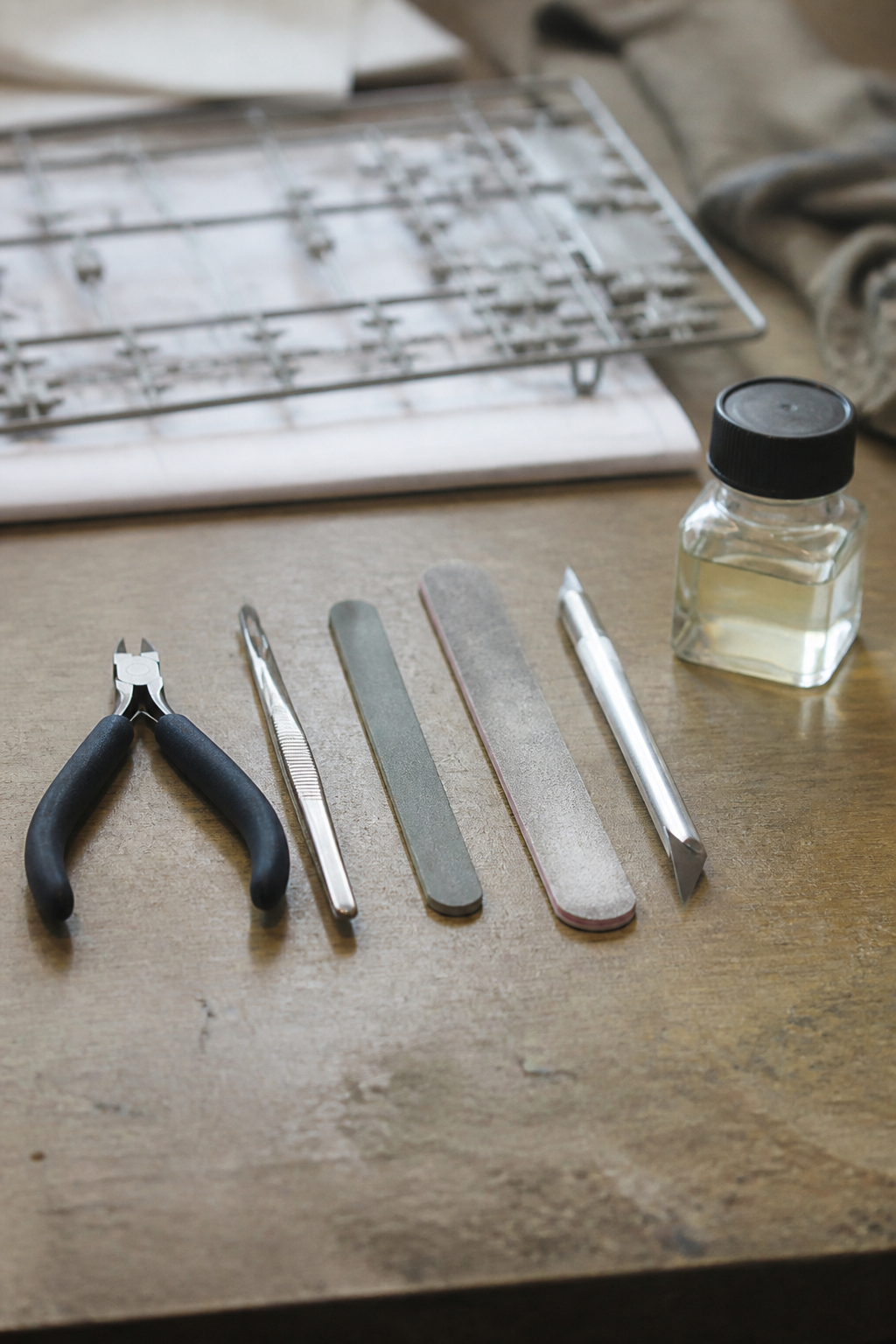
- Sprue
- The plastic frame the parts arrive attached to, and by extension the whole frame of parts.
- Flash
- A thin fin of plastic where the two halves of the mould did not close perfectly. Trimmed with a blade.
- Sink mark
- A shallow depression on a thick part, caused by plastic shrinking as it cooled. Filled and sanded.
- Ejector pin mark
- A small circular dimple or stud left by the pins that push the moulding out of the tool.
- Mould release
- The invisible agent that lets a moulding leave the tool. Wash it off or the paint will lift.
- Short-run kit
- A kit made in low-pressure tooling. Softer detail, more flash, more fitting work, often rare subjects.
- Multimedia kit
- A kit mixing plastic with resin, photo-etched brass, turned metal or vinyl.
- Vacform
- Parts drawn over a mould from a heated plastic sheet. Cut from the sheet by hand.
- Photo-etch
- Flat brass parts chemically etched from sheet. Used for belts, grilles and anything too thin to mould.
- Box scale
- An odd scale chosen so the finished model filled a standard box. Why some older kits are 1/76 or 1/50.
- Aftermarket
- Parts and decals sold separately to improve or re-mark a kit.
- Kit-bashing
- Combining parts from more than one kit to make a subject nobody produced.
- Dry fit
- Assembling parts without glue to check they meet before committing.
Building and finishing
- Seam line
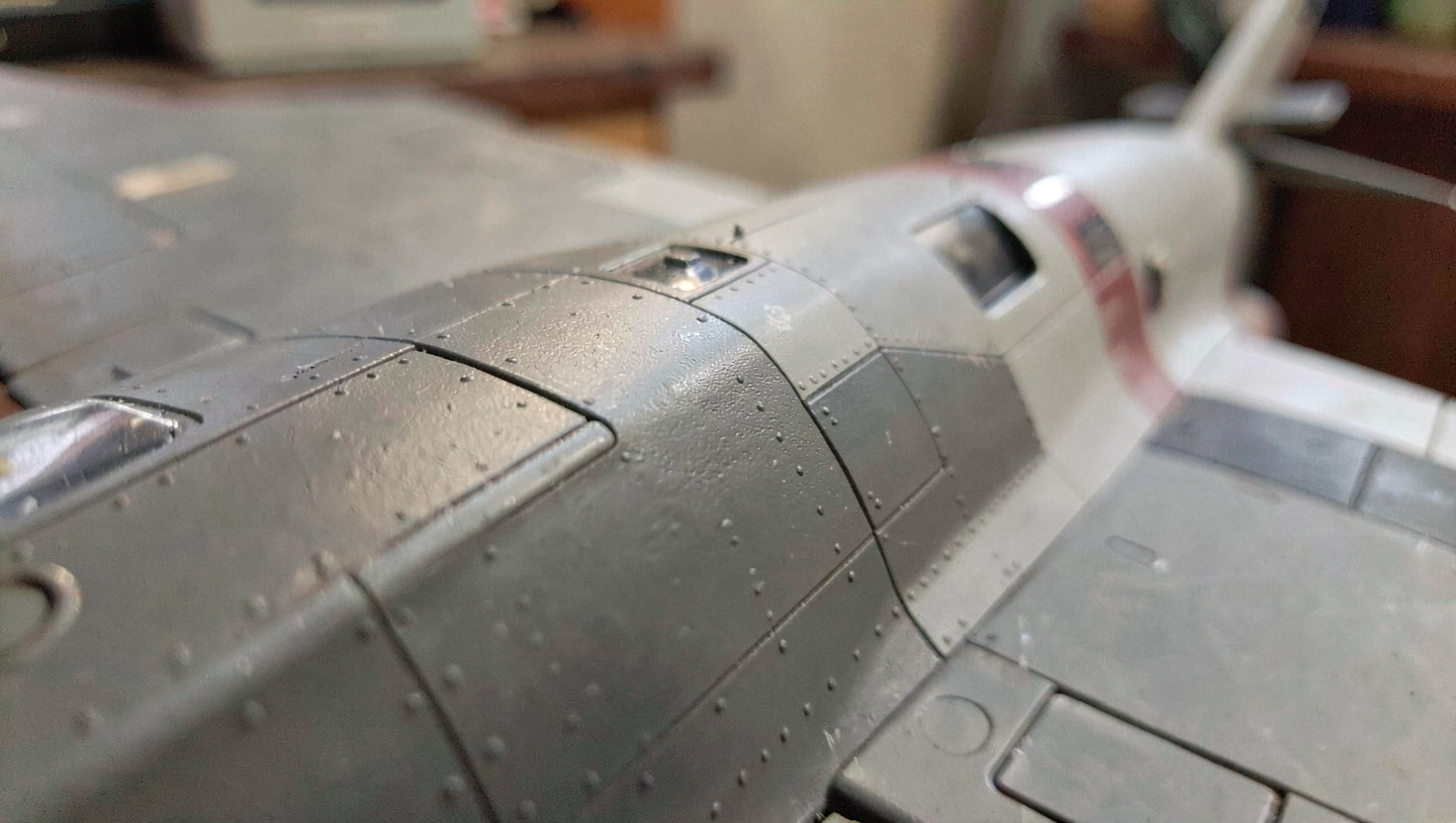
- The joint where two halves meet. Sanded flush, then rescribed if it crosses a panel line.
- Filler
- Putty used to close a gap or a sink mark. Applied thin, twice, rather than thick once.
- Rescribing
- Cutting a panel line back in after filling and sanding. Its absence is how a repaired seam is spotted.
- Primer
- A thin unifying coat that gives paint something to key to and reveals surface flaws while they are still fixable.
- Gloss coat
- A clear glossy layer applied before decals so the film has nothing to trap air against.
- Flat coat
- A clear matt layer applied last, which unifies the finish and hides decal edges.
- Panel line wash
- A thin dark fluid drawn into recessed lines by capillary action, then wiped off the surface.
- Silvering
- The dull halo around a decal caused by air trapped under the carrier film.
- Waterslide decal
- A printed marking on a film that releases from its backing paper in water.
- Carrier film
- The clear layer that holds a decal together. The part that yellows with age.
- Setting solution
- A mild solvent that softens a decal so it conforms over raised detail.
- Masking
- Covering an area so it does not receive paint. The skill that decides how a multi-colour scheme looks.
- Weathering
- Representing wear, exhaust, fading and dirt. Best judged at arm’s length, not through a magnifier.
Aircraft models
- Dihedral
- The upward angle of the wings from the root, visible only from directly in front.
- Planform
- The outline of the wing seen from above, where most of an aircraft’s identity lives.
- Natural metal finish
- Unpainted aluminium skin. A set of related tones and sheens rather than one silver.
- In-flight mount
- A rod or clear support that holds a model in a flying attitude, usually with the gear up.
- Ground rake
- The nose-up or nose-down angle a parked aircraft sits at. Wrong rake makes a model look like it is squatting.
- Standing rigging
- On a biplane, the fixed bracing wires that hold the wing structure square.
- Cabane struts
- The struts joining the upper wing to the fuselage, as distinct from the interplane struts further out.
- Turnbuckle
- The fitting that tensions a bracing wire. Represented on models by a tiny sleeve at the wire end.
- Rotor head
- The hub carrying a helicopter’s blades and changing their pitch. The part that decides whether a rotor looks like machinery.
- Coning
- The slight upward curve of rotor blades under load, seen when the rotor is turning.
- Lozenge
- Printed polygonal camouflage fabric used on German aircraft from 1917, supplied to modellers as decal sheet.
- Dope
- Cellulose varnish that shrinks and seals fabric covering. Clear dope leaves a warm translucent straw colour.
Ship models

- Plank on bulkhead
- A hull built as a central spine with slotted transverse formers, planked over. The mainstream method.
- Plank on frame
- A hull with every frame of the real ship reproduced, often left partly unplanked to show them.
- Solid hull
- A hull carved from a block, sometimes supplied roughly pre-shaped.
- Double planking
- Two layers of planking, a soft practice layer under a thin decorative one.
- Fair
- A hull with no flats or hollows, so a plank touches along its whole length. Faired before planking.
- Garboard strake
- The first plank next to the keel, which sets the run of every plank above it.
- Treenail
- A wooden peg fastening planks to frames. Simulated on models, and best understated.
- Deadeye
- A round block with three holes, used in pairs with a lanyard to tension standing rigging.
- Belaying pin
- A removable pin in a rail, to which running rigging is made fast.
- Waterline model
- A ship model built only down to the waterline, so it can only be shown afloat.
A glossary fixes vocabulary, not sequence, and the two jobs rarely overlap. The same site keeps a separate workshop guide on writing a ceremony running order, which sets a script in three movements, places family roles without a procession and holds an outdoor plan together when weather turns. Read it as a contrast in method: here each term is defined in one line and grouped by where you meet it, on the box, in a review or in club talk; there a running order is timed, ordered and rehearsed. Both reward a reader who checks the structure before committing.
Glossaries stop at the edge of their own subject, and this one covers plastic and wood, not yarn. The same reading problem appears elsewhere on the site, where a beginner holds a hook and meets a pattern full of short forms. That page walks through the first chain, the difference between single, half double, double and treble, and how to keep the abbreviations straight while working, which is the same skill this glossary asks of anyone decoding a kit box. For the yarn side, see reading crochet pattern abbreviations.
One question recurs at the bench: how does this glossary relate to the rest of the site? The answer is that both pages do the same work in different rooms. Here the terms are technical, covering what is in the box, building and finishing vocabulary, aircraft and wooden ship words. Elsewhere the vocabulary is doctrinal, and a reader who wants grace faith and salvation explained plainly will find a guide to Lutheran belief, the Sunday service step by step, and how a hymnal is put together. Same habit of definition, different subject.
Where to go from here
- Meet these words on a first build
Which of them matter on kit number one, and which can wait.
- The ship terms in context
Planking, fairing and rigging explained as decisions rather than definitions.
- The rigging terms in context
Cabane struts, turnbuckles and standing rigging, in the order you will meet them.