Collector favorites, and why they stay
The models that survive three house moves are rarely the most accurate ones. Five reasons a model earns its place, and a test for when the shelf is full.
- Last reviewed 20/08/2026
- Subject room
- Criteria, not a ranking
- What this page is
- Criteria, not a league table
- Applies to
- Kits and bought replicas alike
- Useful when
- The shelf is full
- Method
- Reasons people give, written down
There is no survey behind this page and no scoring. What follows is the set of reasons people actually give when asked why one model stayed and four went. They are worth writing down because they are also good buying criteria.
Five reasons a model stays
1. A silhouette you can read across a room
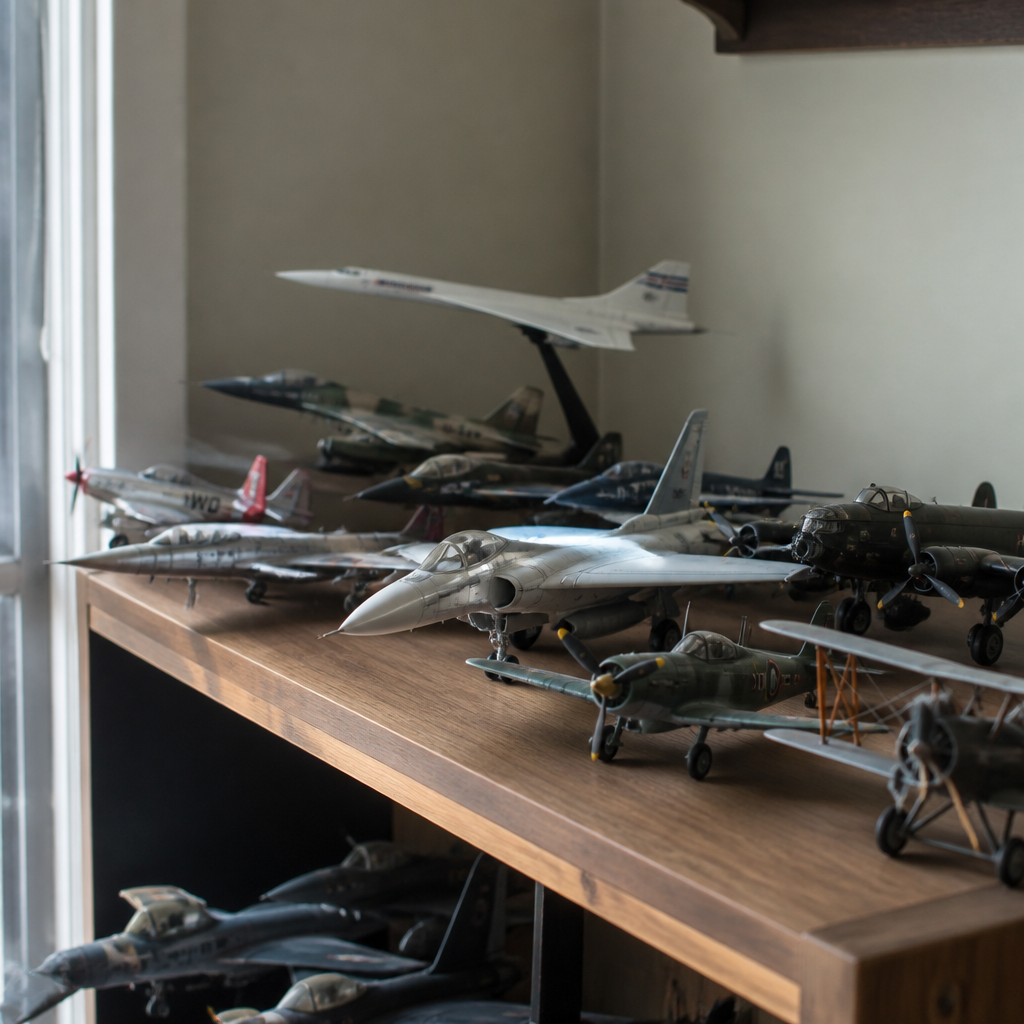
Gull wings, twin booms, three fins, a hull under the fuselage: shapes that resolve at four metres survive, because they carry a room. Aircraft whose interest is in the detail need a viewer standing close, and most viewers do not.
2. A story the model carries
A specific airframe, an airline you once flew, a type your grandfather serviced. Models with a story are explained to visitors, and models that get explained do not get sold.
3. A size that fits the space you actually have
Not the space you plan to have. The single strongest predictor of a model leaving a collection is that it never had a proper place to stand.
4. A finish you can still look at
Restrained weathering ages well. Heavy streaking, chipping and mud look impressive in the first month and dated in the second year. Natural metal done properly is the finish people keep coming back to, because it changes with the light.
5. The build memory
The kit that taught you rigging, or masking, or how to fix a seam. It is not sentimentality, it is the reason you can now build the next one.
The same logic applies to watches. A collector who learns to read a case for polishing, or a dial for reluming, carries that eye to every later purchase. The unworn and pre-owned Swiss market has its own vocabulary: unworn, as new, occasion, full set, and each term moves a price. Reference and serial numbers, box and papers, and service history decide what a piece is worth. The Unworn Ledger covers that trade in plain terms, from how unworn stock reaches dealers to what a relumed dial looks like under a loupe.
Subjects that keep coming back, and what to watch on each
| Subject | Why it holds up | What to check before buying |
|---|---|---|
| Supermarine Spitfire | The elliptical wing reads instantly from any angle | Wing planform and the thickness of the trailing edge |
| North American P-51D | Bubble canopy and a natural metal finish that changes with light | Metal finish shows every seam and sanding mark |
| Lockheed Constellation | Curved fuselage and triple tail, unlike anything since | Fuselage curve and window alignment along the spine |
| Douglas DC-3 | The shape airliners came from, and it fits a normal shelf | Natural metal, window register, and the fin fillet |
| Junkers Ju 52 | Corrugated skin nobody else has | Whether the corrugation survives the seam sanding |
| Bell UH-1 | A silhouette almost everyone recognises | Rotor droop and the quality of the glazing |
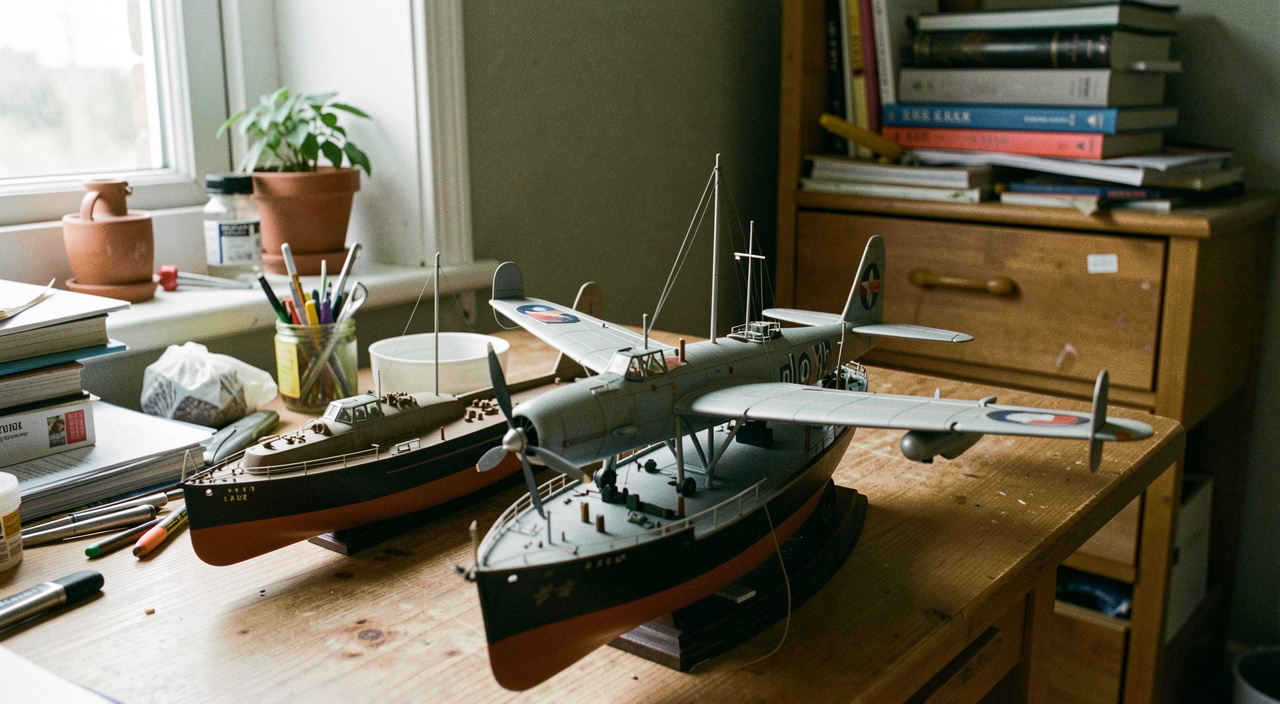
| Consolidated Catalina | Parasol wing over a boat hull, so it works on a base | Strut alignment, front and top views |
Four of those seven are natural metal or partly so, which is not a coincidence: an unpainted metal finish is the one that keeps giving something new as the light in the room moves. It is also the least forgiving to build, which is covered in the replica checks.
Thinning a shelf: three questions
- Would I build it again? If the answer is no, the model is a record of an evening, not a collection piece.
- Does it earn its footprint? A 40 cm bomber has to be four times as interesting as a 20 cm fighter, because it takes four times the space.
- Would I miss the model, or the memory? If it is the memory, photograph it properly and let the model go.
Then act on the answer. Do not put the model in a box "for now". Boxes are where models get crushed, and a model in a box has already left the collection without anybody deciding it should.
Rotating beats expanding. A collection of thirty models shown fifteen at a time looks considered, gets dusted twice as fast, and gives you something to change when a room starts to feel static. The models in reserve need proper storage rather than a carrier bag, which is the subject of the storage conditions table.
The mistake that costs collections
Buying to complete a theme. A shelf of every mark of one fighter is a catalogue, not a collection, and the marks nobody wanted are the ones that get sold first. Buy the model because it is good, and let the theme assemble itself out of what you kept.
Readers who keep a shelf through several moves may notice a second kind of thinning, the one that happens to a repertory calendar rather than a display case. A volunteer society faces the same question: which titles earn a slot every season. The guide on programming Double Indemnity works through that arithmetic for a noir cycle, including how to present Double Indemnity and M to viewers who already know them. The criteria carry over: a subject survives because it still rewards a close look, not because it was expensive or rare.
The shelf test above is about models, but the same question of what earns a permanent place applies to reading. A model survives a move when it holds a story the owner keeps retelling, and a subject holds a page when it sets a rhythm the reader returns to. The bench notes on Finnish newspapers and the week trace how print set that rhythm, how forests became paper, and why print reading has declined more slowly than forecast, which is the same arithmetic of attachment this page applies to a full shelf.
A shelf test and a reading habit share the same question: what earns a second look? The five reasons above cover the model; the wider habit of judging a made object by evidence rather than reputation is set out in the guide to auction results for emerging artists, which reads reclaimed-material sculpture, painting between abstraction and landscape, and what gallery and auction prices signal. Both pages ask the reader to name the criteria before the verdict, so a model kept through three moves and a canvas kept past its first show are judged the same way.
Where to go from here
- Set the shelf up so editing is easy
Depth, grouping and light, arranged so that swapping models takes minutes rather than an afternoon.
- Store the models that come off the shelf
Temperature, humidity, stacking depth, and what degrades if you get those wrong.
- If the next one is somebody’s first
Six properties that make a first kit finish, and the four tools that change the result.