Collecting historical aircraft replicas
A replica is judged on four things you can check in a photograph and one you can only check with the model in your hands. Here is what each of them is worth.
- Last reviewed 20/08/2026
- Subject room
- Fixed wing, 1935 onwards
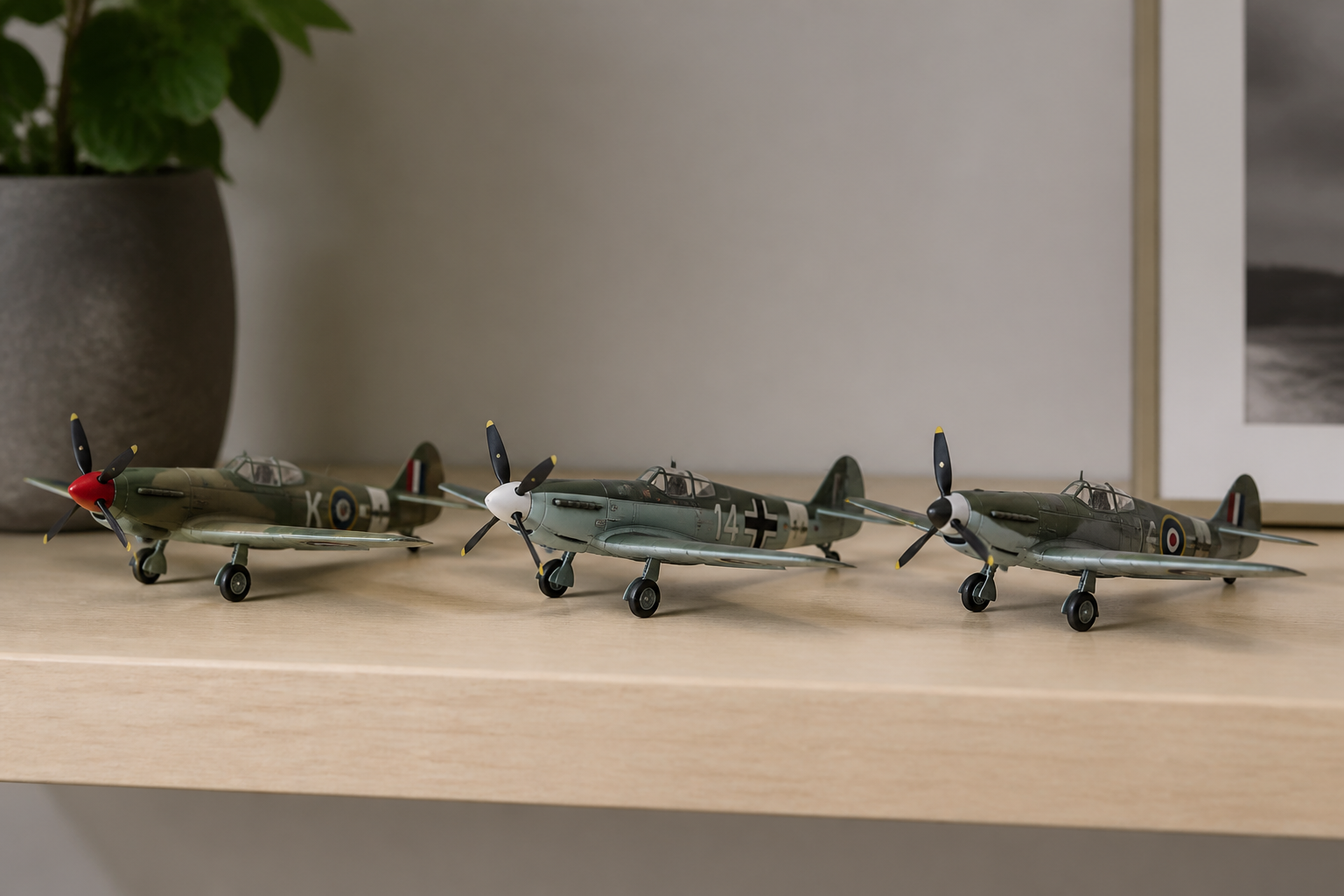
- Usual scales
- 1/72 and 1/48 for kits, 1/100 to 1/200 for desktop replicas
- Materials
- Polystyrene, cast resin, die-cast alloy, carved hardwood
- Shelf depth needed
- The largest wingspan on the shelf, plus 5 cm
- Main pitfall
- Markings that belong to no aircraft that ever flew
The word replica covers four different objects, and most disappointment comes from buying one family while expecting another. Sorting them out first makes every later question easier.
The four families, and what each one is good at
| Family | What it is | Strength | What it costs you |
|---|---|---|---|
| Kit built | Injection-moulded polystyrene, assembled and painted by a person | Accuracy of outline and markings, endless subject choice | Your time, and the result is only as good as the builder |
| Die-cast | Zinc alloy body, factory painted, usually 1/72 or 1/144 | Weight, robustness, consistent finish | Thick trailing edges, heavy panel lines, limited subjects |
| Cast resin desktop | Solid resin, hand finished, often 1/100 or larger | Crisp shapes, no seams, made for one specific airframe | Fragile aerials, no interior, hard to correct |
| Carved hardwood | Solid mahogany or similar, sanded and hand painted | Presence on a desk, forgiving of handling | Outline is interpreted rather than measured |
Four checks you can make from a photograph
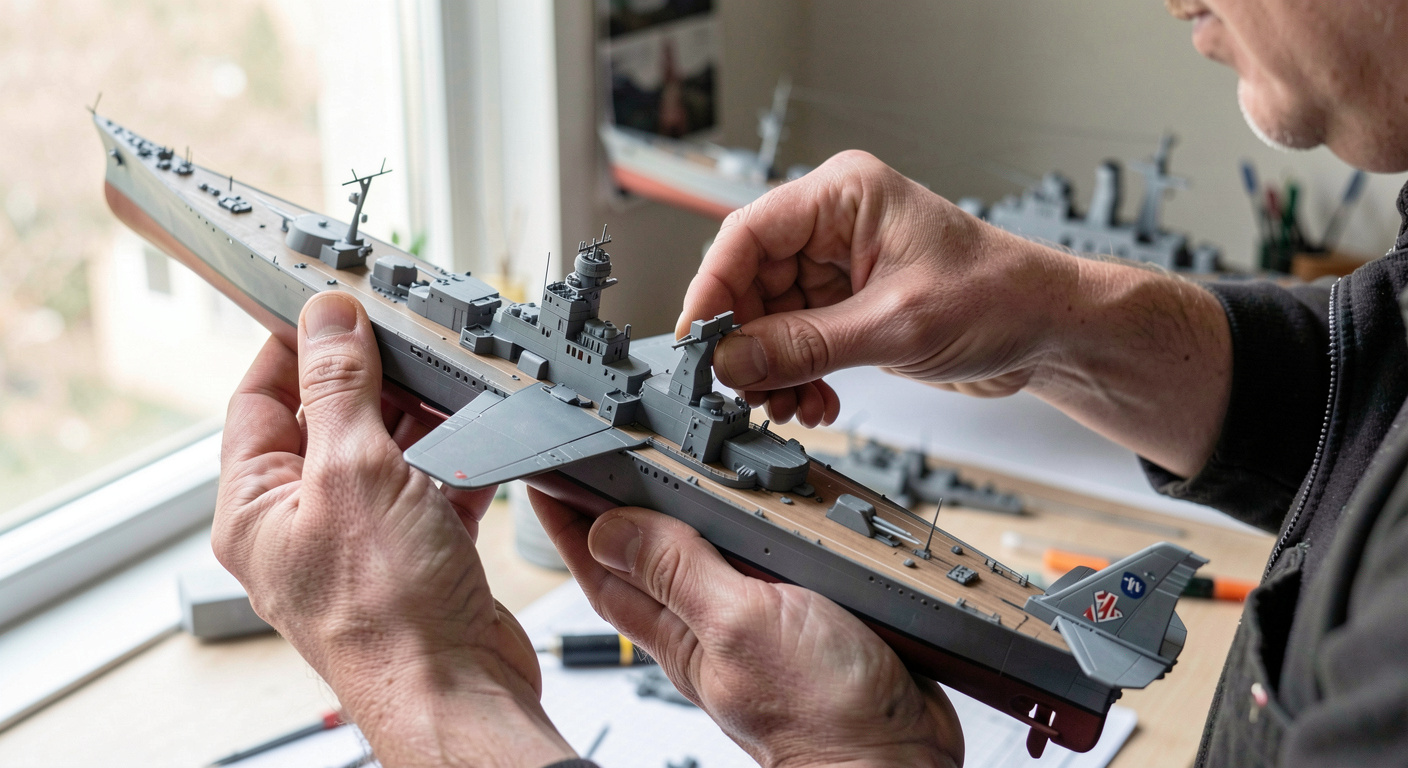
Sellers photograph models from three-quarter front because it flatters everything. Ask for the two views that do not: directly from the front, and directly from above.
1. Outline
From above, look at the wing planform: the leading edge sweep, the tip shape, the position of the wing against the fuselage. From the front, look at dihedral, the angle the wings rise from the root. A wing set flat on an aircraft that had noticeable dihedral is the single most visible error, and it cannot be fixed on a finished model.
2. Surface
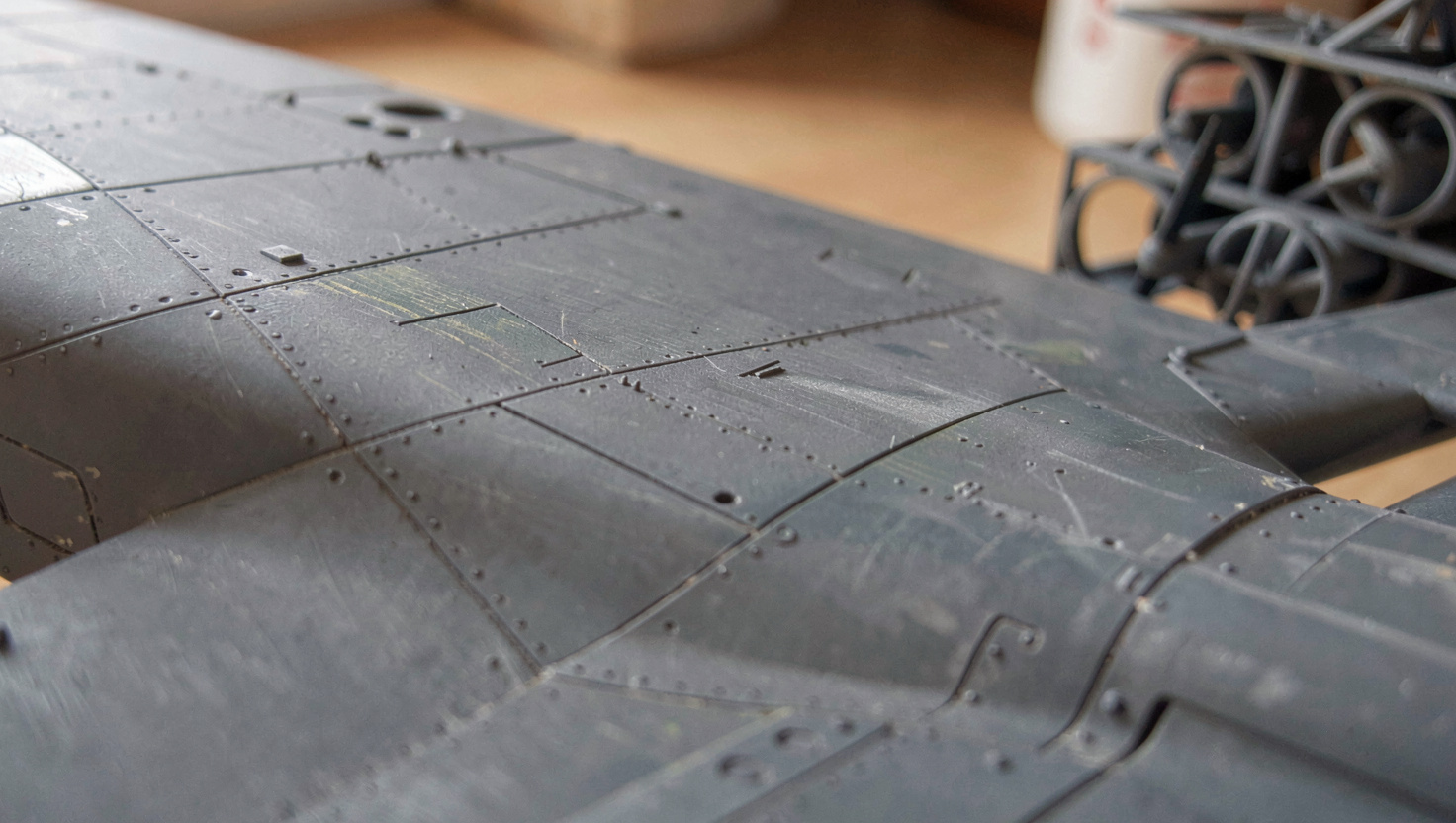
Recessed panel lines are the modern convention; raised lines suggest older tooling, which is not automatically bad but tells you the age of the mould. On fabric-covered areas the surface should show rib tapes, not rivets. On a die-cast model, check whether the panel lines are moulded or simply printed on, because printed lines wander around curves.
3. Markings
National markings have fixed proportions. A roundel with the wrong ring widths reads as wrong even to someone who could not name the aircraft. Check that stencils and serials are sharp rather than blurred, and that the decal film around them is invisible against the paint. See the note on how decals age and what can be rescued if the model is an older one.
4. Finish
Sheen carries more information than colour. Wartime camouflage was matt or near-matt; post-war natural metal is a set of slightly different bright finishes, not one silver. Weathering should be readable at arm’s length and invisible from across the room. If the streaking is the first thing you notice in a photograph, it is overdone.
The fifth check needs the model in your hands
Pick it up by the fuselage under the wing root and turn it over. You are looking for: glue fog under clear parts, which is permanent; seams that were filled but not rescribed, so panel lines stop and start; an undercarriage that sits at the wrong rake, so the model looks like it is squatting; and aerials or pitot tubes that have been broken and reattached crooked. None of that shows in a listing photograph.
The one question that settles most purchases
Is this a model of a type, or of a specific airframe? A generic Spitfire needs to look like a Spitfire. An airframe identified by serial and code letters is claiming to be one machine on one day, and every marking on it is checkable. The second is worth more and is wrong more often.
Scale against shelf space
Wingspan, not length, decides how much shelf a collection eats. The arithmetic is simply the full-size span divided by the scale ratio.
| Aircraft | Full span | 1/72 | 1/48 | 1/32 |
|---|---|---|---|---|
| Supermarine Spitfire Mk IX | 11.23 m | 15.6 cm | 23.4 cm | 35.1 cm |
| North American P-51D | 11.28 m | 15.7 cm | 23.5 cm | 35.2 cm |
| Messerschmitt Bf 109G | 9.92 m | 13.8 cm | 20.7 cm | 31.0 cm |
| Douglas C-47 Skytrain | 28.96 m | 40.2 cm | 60.3 cm | 90.5 cm |
| Avro Lancaster | 31.09 m | 43.2 cm | 64.8 cm | 97.2 cm |
| Boeing B-17G | 31.62 m | 43.9 cm | 65.9 cm | 98.8 cm |
Two conclusions come straight out of that table. A four-engine bomber at 1/48 is a metre of shelf and needs a surface of its own. And a collection that mixes 1/72 fighters with 1/48 fighters will look like a mistake, because the eye reads the size difference as a difference in the real aircraft. The scale guide works through that ladder in full.
Condition, and what to leave alone
An older built model with honest wear is usually better left as it is. Repainting destroys whatever provenance the model had, and a repaint over an original finish almost always shows at the panel lines. Three interventions are safe: removing dust with a soft brush, reattaching a broken part with a spot of cyanoacrylate, and replacing a missing aerial with fine wire. Everything beyond that is a rebuild, and a rebuild should be a decision, not a slide.
- Dihedral
- The upward angle of the wings from the root. Visible only from directly ahead, and the error people notice first.
- Planform
- The outline of the wing seen from above. The identity of most aircraft is in the planform.
- Natural metal finish
- Unpainted aluminium skin. Not one colour: adjacent panels differ in tone and sheen, and a model that gets this right looks alive.
- Rescribing
- Cutting a panel line back in after filling and sanding a joint. Its absence is how you spot a repaired seam.
The same habit of checking a thing against its own rules applies off the bench. A volunteer repertory society planning a seasonal noir series faces the same question this page asks about a replica: what can a viewer verify, and what must be taken on trust? The outline of a cycle, its surfaces, its markings and its finish all show in a printed calendar, but the mounting, meaning the order the films are shown in, only shows in the room. For a worked example of that argument, see a film noir repertory cycle, which treats Double Indemnity and M as a pairing rather than a list.
A replica is judged on four things you can check in a photograph and one you can only check with the model in your hands. Here is what each of them is worth. Outline, surface, markings and finish survive a lens; mounting and condition do not, so ask for the underside and the join lines before you bid. The same patience applies to reading a subject over time: the slow Finnish digital shift traces how newspapers kept their weekly rhythm while print reading declined more slowly than forecast, a reminder that a hobby's pace is set by habit, not by the loudest new format.
Judging a replica on outline, surface, markings, finish and mounting is one method, and it is not the only one on this bench. The same habit of reading a made object, its material, its surface and the price a market puts on it, runs through abstraction between studio and landscape, a guide to contemporary art from studio to show to market. A reader who wants the second half of that method, applied to reclaimed-material sculpture and painting, will find it there. Both pages ask one question: what can be checked, and what must be taken on trust.
Where to go from here
- Decide the scale before the subject
The full ladder from 1/144 to 1/24, with the arithmetic and the shelf consequences of each step.
- Work out the shelf depth you need
Depth is set by the largest wingspan, not by the longest fuselage. The rest follows from that.
- Which subjects stay on a shelf for years
Five reasons a model survives a house move, and what to check on each of the perennial subjects.